
By now, most of us have seen the latest Marvel superhero movie Black Panther. With an extremely high Rotten Tomatoes score and a dominating presence in the box office, it is safe to say that Black Panther was a massive hit for fans of Marvel and non-fans alike. Myself being a non-fan, or at least someone who never read a single Marvel comic book, I loved the film. From the gripping action scenes to the cunning dialogue to the captivating plot, Black Panther had it all. It is not a perfect film however, because I realized it had a main shortcoming: Killmonger, the main villain, was surprisingly hard to root against.
His life's purpose is to avenge the wrongdoings perpetrated on his ancestors whom descended from Africa and to finally achieve equality between the races. He understands that even today, the idea of a truly equal world has yet to be fulfilled.
To sum up the movie, the projected main protagonist is King T'Challa who is trying to maintain his place throne from the disenfranchised main antagonist Erik "Killmonger" Stevens, or Killmonger for short. Right from the start of the movie, it took awhile for me to distinguish who was the "bad guy" of the movie. Future King T'Challa's uncle was accused of smuggling Vibranium out of their homeland, a serious crime since Vibranium is very potent and can be easily weaponized. His uncle, N'Jobu was correctly accused however a scuffle occurred shortly after and he was killed, leaving behind his son who just so happens to be named Erik Stevens.
Killmonger grew up in the unenviable slums in Oakland and experienced first-hand on what it is like to be black a foreign land, in this case anywhere that is not in Africa. He was the one that discovered his dad was killed and concluded it was to stop his father's work. Like Hannibal (the fabled Carthaginian general, not the serial killer), he vowed to continue his father's work.
Killmonger realized how unequal life was as an African-American and fueled by vengeance, he knew he needed to do something. His solution was to have a massive widespread uprising where the oppressed will overthrow their oppressors. Smuggling conventional weapons was too tedious so he looked elsewhere for superior weaponry, Wakanda. Once he heard the Wakandan throne was up for grabs, he jumped at the chance and decided to challenge T'Challa himself for control over Wakanda and more importantly, its Vibranium cache. Killmonger believed by seizing control of the cache, he can distribute it to all corners of the globe and use it to produce weapons to finally achieve equality. This is in stark contrast to the ideology of T'Challa, where he too wants to continue his late father's legacy: isolationism and neutrality. For most of the movie, King T'Challa wanted to just watch the inequality and injustices being subjugated on people from his continent. In fact, he didn't even want to take in refugees, from other African countries.
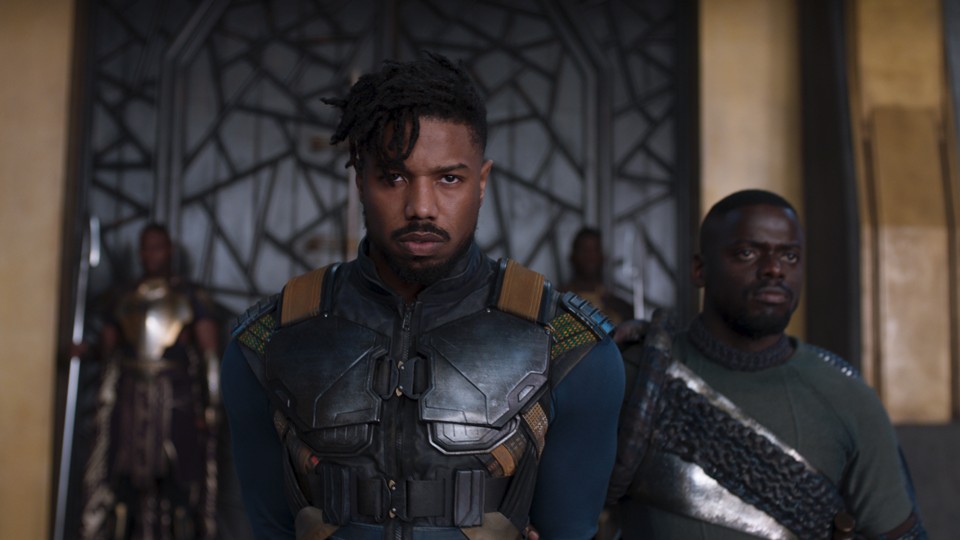
This was very frustrating to Killmonger and it prompted him to interrogate the Wakandan court "Two billion people all over the world who look like us whose lives are much harder, and Wakanda has the tools to liberate them all...Where was Wakanda?" He loathed Wakanda acting as a bystander where it could've prevented slavery of his people from happening. Not only that, Wakanda never helped and is not helping the oppressed blacks of the world because of fears that by helping others, Wakanda will be exploited like all the other African countries. Also, to prevent Wakanda from regressing to its conservative policies, he burned all the heart-shaped herbs that grant superpowers. This was done so he can consolidate power and once that was done, his dream of finally liberating his people from oppression will come to fruition. With complete power, he does not have to listen to remaining isolationists among his midst. Somebody who is willing to die for something they believe in already has my respect. Somebody who is willing to die for true equality and an end to apartheid is even more noble.
Fast forward to the end of the movie, Killmonger is defeated by King T'Challa and when extended a hand of mercy, he rejected it. His logic was a racially and historically charged one. He instructed King T'Challa to "Just bury me in the ocean with my ancestors that jumped from the ships, cause they knew death was better than bondage." He understood the history of African-Americans and with that, he made his ultimate and final decision. He feels like this is the way to honor his ancestors that were brave enough to not be subjugated to racism and slavery. By choosing death over imprisonment, he at least dies a free man and it is symbolic as it is tragic. He died trying to reach his dream of a liberated black world in one that is not completely still today.
After his death, King T'Challa decided his death should not be in vain and decided to act. T'Challa revisited the site where his dad killed his uncle, orphaning the young Killmonger and creating the whole mess. This move was to finally come to terms that even good men makes mistakes. This move was also largely symbolic since Wakandan centers of cultural learning were established in the very same buildings where N'Jobu died. If Killmonger was truly a supervillain, this subtle nod towards him and his dream of a free black world would not exist.
In the end, I would not consider Killmonger as a supervillain but rather simply an antagonist. His motives were true and pure however, his methods weren't. Will peace and equality achieved by violence and bloodshed last? Either way, while the movie focuses on the T'Challa and his quest to maintain peace, I see the tragic story of Killmonger and his mission to end black oppression. Killmonger died trying to turn his vision of blacks around the world will throw off the yoke of historical racism and slavery as well as overthrow those who are oppressing them into reality. Liberating blacks was his ultimate goal, whether he wanted to achieve it via violence or not, it was him (and his death) that finally sparked change and dragged Wakanda out of isolation.
Black Panther has a lot of allusions to the Civil Rights period that took place in the second half of the 20th century in America. For starters, the movie title was a nod to the Black Panther Party that was a militant group who was concerned with rights for African-Americans. Also the struggle between the peaceful T'Challa and the violent, but ideological Killmonger can be analogized to the differences between Dr. Martin Luther King and Malcolm X of the Civil Rights Movement. In fact, Killmonger's agenda (minus the violence) was and still is trying to solve a prevalent issue in society. The issue of racial prejudice and even lingering oppression of blacks in places.
Works Cited
https://nerdist.com/black-panther-killmonger-deluxe-figure-hot-toys-collectible/
https://www.theatlantic.com/entertainment/archive/2018/02/black-panther-erik-killmonger/553805/
https://www.youtube.com/watch?v=XWc-wda51FE
This is very well written and I think your insight on the character Killmonger is eye opening. I agree with you that the "villain" of the film is really more of an antagonist, but I also would like to argue that because of the complexity of the issues the movie attempts to address, that this is not a flaw. Killmonger acts as a catalyst to spur T'Challa and Wakanda into taking a more active role in pursuing equality for all.
ReplyDeleteI really enjoyed reading your blog post. I, too, greatly enjoyed the movie and went to see it more than once. I find it interesting how you addressed the protagonist as more of an antagonist working for good. Taking this information from the movie, it's easy to apply it to your own life and wonder if you avoid helping others sometimes at the expense of your own personal costs. However, the question can be asked if whether or not the Black Panther was still able to provide for others in a positive way. It may not have been to the extent that Killmonger was wanting, but was the good that the Black Panther performed to a far enough extent? The other thing to consider is that the extent of how much to help others was not at the expense of Black Panther alone, but to him and his people, as a whole. So Black Panther had to consider the safety of the entirety of his people.
ReplyDeleteI haven't seen this movie but I found this post to be extremely insightful in the way that it discusses how there's no true hero or villain. Everyone is human, and even with good goals depending on how you go about achieving them changes on if you are viewed as the hero or villain. I also may wonder if this is a slight case of the victor writes the history. The Black Panther may have been in the wrong by not standing up for his people living outside his nation but since he won the battle for the throne he is the hero in the story.
ReplyDelete